Società Agricola CortedelBoiardo
Organic Farm and
Parmigiano Reggiano
SlowFood presidium
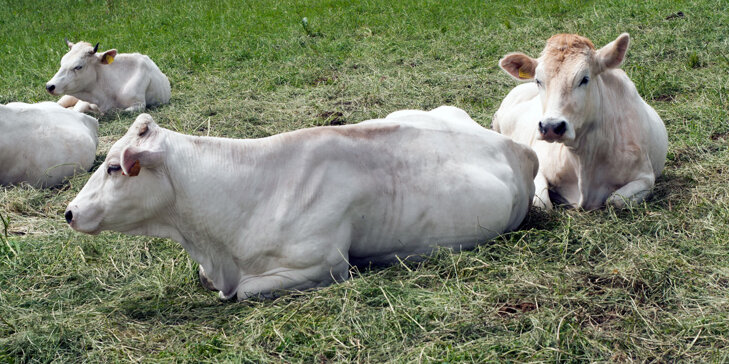
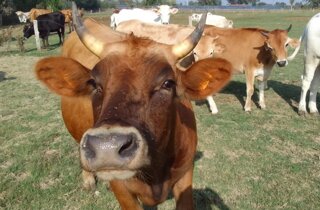
We raise a limited number of cattle on extensive farm pasture like in the old times.
Società Agricola CortedelBoiardo, eccellenza biologica.
According to historical animal husbandry accounts, the introduction into Italy of cattle with grey or white coats and large horns – traceable to the Podolian stock of the steppe – is traditionally associated with the migrations of Germanic and Asian peoples (such as the Huns, Lombards and Ostrogoths) who, from the 5th century AD onwards, crossed the Po Valley bringing their herds with them.
However, the most widely accepted scientific and academic view identifies the Bianca Modenese not as a ‘pure’ breed introduced by the barbarians, but rather as the result of centuries of cross-breeding within the region:
The indigenous component: cattle with a Fromentino coat (similar to the Rossa Reggiana) already present in the Po Valley.
The exogenous component: grey cattle of the Podolian type, which arrived as a result of the historic waves of migration or subsequent trade.
This genetic mix gave rise to a breed defined as having ‘triple aptitude’ (draught, beef and dairy), characterised by a splendid milky-white coat and extraordinary hardiness.
Evolution and connection to the territory
The earliest written records identifying the Bianca Modenese as a distinct population date back to the late nineteenth century, pinpointing its original centre in the Carpi area.
From there, the breed spread rapidly throughout the provinces of Modena, Reggio Emilia, Mantua and Ferrara, becoming the backbone of local agricultural production.
The decline and revival as a Slow Food Presidium
In the post-war period, the Bianca Modenese faced the risk of total extinction. From over 140,000 head in the 1950s, the population plummeted to just a few hundred due to the introduction of the Dutch Friesian, which was far more productive in terms of quantity and suited to mechanical milking.
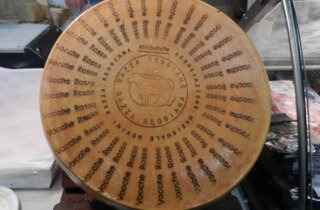
Today, the breed is protected as the Slow Food Presidium of the Bianca Modenese. Its milk, although limited in volume, possesses exceptional dairy qualities – thanks to a perfect balance between fat and protein and a high content of the K variant of casein – which make it ideal for the production of a rare and highly prized single-breed Parmigiano Reggiano.